
Whether you are upgrading your home or simply replacing a tired fitting, understanding how a cylinder lock works is the first step toward making a smarter, safer choice for your property. This guide covers everything — from basic mechanics to the most advanced security standards available today.
Introduction:Cylinder Lock & Door Security
Most homeowners focus on alarm systems and CCTV when thinking about home security, but the truth is simpler: your front door is only as safe as the cylinder locks installed in it. A high-quality cylinder lock is your property’s single most important physical barrier against intruders, yet it is also one of the most misunderstood components in door hardware.
According to Home Security, the majority of forced entries in the UK involve manipulation or snapping of poorly rated lock cylinders. A risk that can be dramatically reduced simply by choosing the right product and having it professionally installed.
What Is a Cylinder Lock?
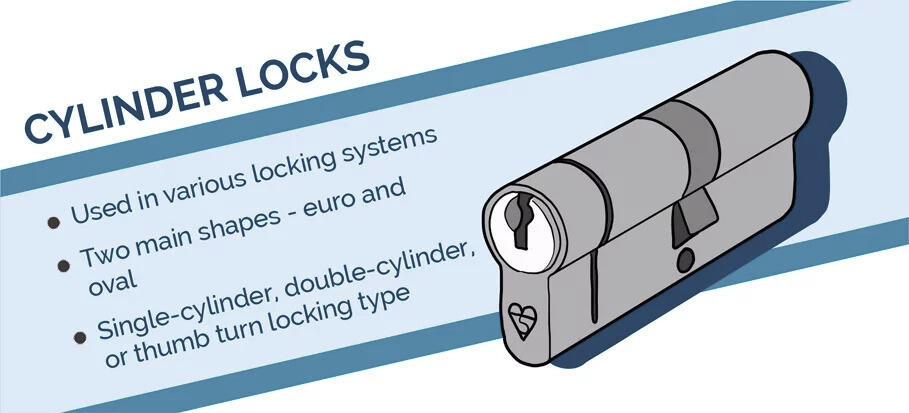
A cylinder lock is a locking mechanism in which the key-operated core, known as the plug or cylinder, sits inside a housing fixed to the door. When you insert the correct key and turn it, the internal pins align, the plug rotates, and the bolt engages or disengages. The entire mechanism is self-contained within a cylindrical barrel, which gives this lock type its name.
A lock is found in everything from residential front doors to communal entry systems and office buildings. They are among the most widely installed door security mechanisms worldwide because they are compact, reliable, and available in a wide range of security grades to suit every budget and threat level.
How Does a Cylinder Lock Work?
Inside every lock, a set of spring-loaded driver pins and key pins are stacked in chambers running through the plug and housing. When no key is present, driver pins cross the shear line — the boundary between the plug and the outer housing — preventing rotation.
When the correct key is inserted, its unique cuts push each key pin to exactly the right height, lifting every driver pin to the shear line simultaneously and allowing the plug to rotate and operate the door bolt. Modern high-security cylinder locks add anti-pick pins, anti-bump protection, and anti-drill cores to this foundation.
Types of Cylinder Locks
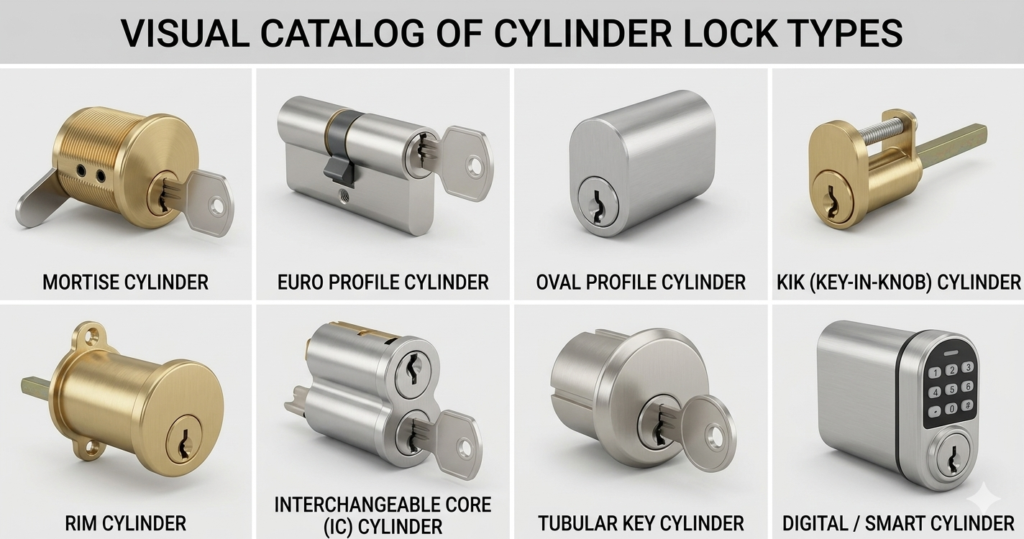
Euro Cylinder Lock
The euro cylinder is the most popular format in the UK and across Europe. Shaped like the letter “D” when viewed from above, the euro cylinder lock fits uPVC doors, composite doors, and aluminium frames and is the standard format for most multipoint locking systems.
Euro locks come in a range of sizes measured in millimetres from the centre screw hole to each end. Getting the size right is critical — an exposed euro cylinder lock that protrudes beyond the door face is vulnerable to snapping attacks, where thieves use physical force to break the cylinder in two and access the bolt mechanism directly.
Oval Cylinder Lock
Popular in southern Europe and sometimes found in older UK properties, the oval lock cylinder has an elliptical profile. It is not as widely stocked in the UK, but high-security versions are available for properties that require this format.
Round / Rim Cylinder Lock
Often used in rim night latches, the round cylinder with lock housing attaches to the surface of the door rather than fitting into it. These are common as secondary security measures alongside mortice locks and are particularly popular on older timber doors.
Mortice Cylinder Lock
Fitted inside the door edge, the mortice cylinder lock operates a dedicated mortice bolt. It is frequently used in commercial settings and on fire doors where a flush, clean finish is required.
Euro Lock Cylinder Sizes
The cylinder euro market uses a simple sizing convention. A euro cylinder labelled “35/45” measures 35 mm from the centre screw hole to the outer (thumb-turn) end and 45 mm to the keyhole end — giving a total length of 80 mm.
For maximum security, the external end of your door lock cylinder should sit flush with — or no more than 3 mm proud of — the door’s outer face. This denies attackers the leverage needed to snap the cylinder. If you are unsure of your exact requirement, contact a qualified locksmith for professional sizing advice before purchasing a replacement.
Security Ratings
Not all cylinder locks offer the same level of protection. Security ratings help you understand exactly how much resistance a particular lock provides against the most common attack methods.
TS007 Star Ratings
In the UK, the TS007 standard is the most widely recognised benchmark for cylinder lock security. Cylinders are tested against picking, bumping, drilling, and snapping:
- 1-star: Resistant to standard attacks; suitable as part of a combined door set
- 2-star: Higher resistance; often paired with a 1-star security handle for a combined 3-star rating
- 3-star: The highest single-component rating; recommended for high-risk properties
Security professionals and insurers typically recommend a 3-star high-security cylinder lock that meets or exceeds the TS007 3-star standard. This is particularly important for uPVC and composite doors, where cylinder snapping remains a genuine threat.
Secure & Insurance Approvals
Many leading locks also carry Sold Secure Diamond or Gold ratings and appear on insurer-approved product lists. If your home insurance specifies a required security standard, always verify that your chosen lock meets that requirement before installation.
Anti-Snap Cylinder Locks
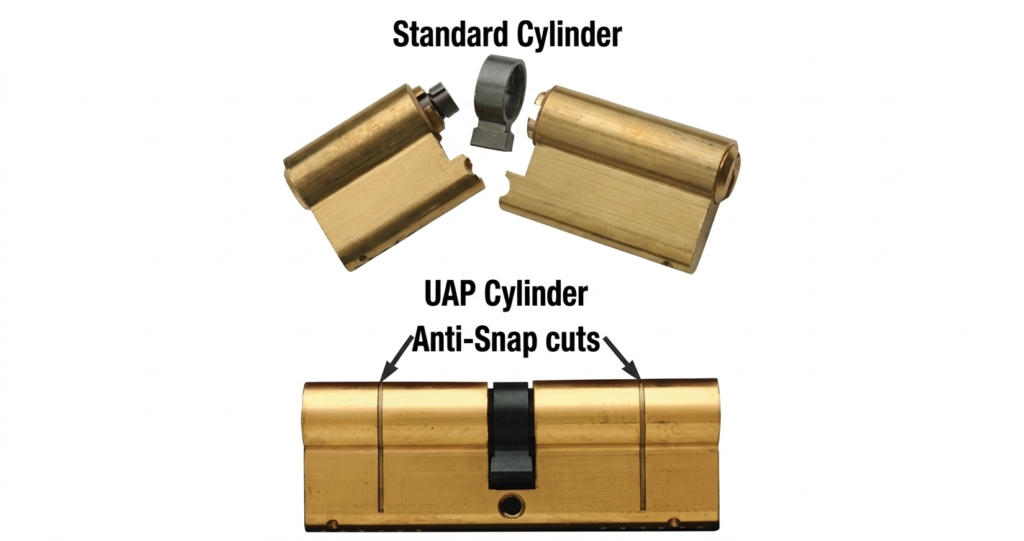
Lock snapping is one of the most prevalent forms of burglary in the UK, particularly where uPVC doors are common. A standard euro cylinder lock protruding more than 3 mm from the door face can be snapped using pliers and brute force in seconds — completely bypassing the lock.
Anti-snap cylinder locks are engineered with a deliberate sacrificial break point. When attacked, the outer section of the door lock cylinder shears away, but the inner section — which operates the bolt — remains fully intact. The mechanism continues to secure the door even after the attack, making any euro lock cylinder without anti-snap technology an unacceptable choice for UK residential use today.
Anti-Pick, Bump & Drill Features
Beyond snapping, a high-quality lock should resist several other common attack methods:
- Anti-pick: Security spool or mushroom pins inside the cylinder lock create false sets that frustrate picking tools.
- Anti-bump: High-security cylinder use secondary locking mechanisms or tighter tolerances to defeat bump key attacks.
- Anti-drill: Hardened steel or tungsten carbide inserts protect the cylinder with lock housing against rotary drill attacks on the pin stack and cam.
How to Replace a Cylinder Lock
Replacing a cylinder lock on a uPVC or composite door is a straightforward DIY task if you have the correct tools and the right cylinder size:
- Step 1: Measure your existing door lock cylinder from the centre screw hole to each end and note both measurements.
- Step 2: Open the door and locate the single retaining screw on the door edge that secures the cylinder in place.
- Step 3: Remove the screw, insert the key and turn slightly to retract the cam, then slide the cylinder out.
- Step 4: Purchase a matching-size euro lock cylinder with the security features appropriate for your property.
- Step 5: Slide the new cylinder lock into position, replace the retaining screw, and test the key fully before closing the door.
If your door was the subject of a break-in attempt or if the existing cylinder lock is damaged, always have a professional carry out the replacement. A local locksmith can also assess whether your door and frame provide adequate security alongside the new cylinder.
When Should Call a Professional Locksmith?
While replacing a lock is often a DIY job, there are situations where a qualified locksmith is essential:
- You are locked out and cannot access your property.
- Your cylinder has been damaged in a break-in or attempted attack.
- You want to upgrade to a high-security lock and are uncertain of the correct size or specification.
- Your door or frame shows damage that could compromise the effectiveness of a new lock.
- You need multiple locks rekeyed or configured on a master key system.
A qualified, DBS-checked emergency locksmith can assess the full security picture and install the right lock to the manufacturer’s specification — giving you genuine peace of mind rather than just new hardware.
Key Control
One often-overlooked advantage of upgrading to a premium lock is key control. Budget cylinder use keys that can be duplicated at any high-street kiosk without authorisation. If you have ever given a key to a tradesperson, a previous tenant, or someone you no longer trust, your property may be less secure than you realise.
Premium security cylinders use patented key profiles that can only be duplicated by authorised dealers with proof of ownership. This means you always know exactly how many keys to your door lock cylinder exist — a crucial feature for landlords, businesses, and anyone managing shared access.
Smart Cylinders and Keyless Entry
The traditional lock is evolving. Smart cylinders replace the key-operated plug with an electronic actuator that responds to PIN codes, key fobs, or smartphone apps. They fit the same euro cylinder housing used by conventional cylinders, making them a straightforward retrofit for most modern doors.
Smart cylinder locks offer temporary access codes for visitors, audit trails showing when the door was operated, and remote locking via a smartphone. However, they introduce different vulnerabilities — battery failure, software issues, and wireless signal interception. So choosing a product from a reputable manufacturer and keeping firmware updated is essential.
Maximising Cylinder Lock Security
- Always fit a cylinder lock flush with the door face — never allow it to protrude more than 3 mm.
- Use a TS007 3-star-rated euro cylinder lock or a 1-star cylinder combined with a 2-star security handle for the same total rating.
- Verify that your door frame and keep are reinforced — a top-rated cylinder lock in a weak frame is still a vulnerability.
- Upgrade hinges to security hinges if your door opens outward.
- Re-key or replace your cylinder lock whenever you move into a new property, after any security incident, or if keys are lost.
FAQs
What is the difference between a euro cylinder lock and a standard cylinder lock?
The term cylinder lock is a general description of any lock using a cylindrical plug mechanism. A euro cylinder lock refers specifically to the D-shaped format standard across Europe and the UK, used in multipoint locking uPVC and composite doors.
How do I know if my cylinder lock is anti-snap?
Look for branding such as “anti-snap”, “snap-safe”, or a TS007 2-star or 3-star rating on the cylinder lock, both of which confirm anti-snap protection as part of the tested specification.
Can I rekey a cylinder lock instead of replacing it?
Yes. A locksmith can rekey many types of lock cylinder to work with a new key, rendering all previous keys useless. This is more affordable than full replacement and is ideal when key control is the primary concern.
How long does a cylinder lock last?
A quality cylinder lock should last 10–15 years under normal use. Signs that replacement is due include stiffness when turning the key, visible wear on the key profile, or difficulty in smooth operation. After any burglary attempt, replacement is always recommended regardless of apparent condition.
Conclusion
Your home’s security begins at the door, and the door’s security begins with the cylinder lock. Choosing a high-quality, correctly sized, anti-snap cylinder lock with a recognised security rating is one of the most cost-effective investments you can make in protecting your property, your possessions, and your family.
Whether you choose a standard euro cylinder lock, a smart keyless entry cylinder, or a patented high-security door lock cylinder with maximum key control, the principles remain the same: fit the correct size, achieve the required security rating, and have it installed by a qualified professional.
If you are ready to upgrade your home’s first line of defence, speak to a trusted locksmith today — because getting your cylinder lock right the first time is always safer than discovering a weakness the hard way.